Jackpots
Power, Extra Power, Super Power, Ultimate Power: the Age of the Gods jackpot game
Four linked pots, a board of 20 coins and a random start on any paid spin. What the Age of the Gods jackpot game really does, and what the published rules…
Jackpots
A progressive jackpot is funded by a small slice of every qualifying bet, so it grows until someone wins it and then restarts from a seed. A fixed jackpot is a set multiple of your stake that never grows. The slice taken for a progressive pot comes out of the return the reels would otherwise pay.
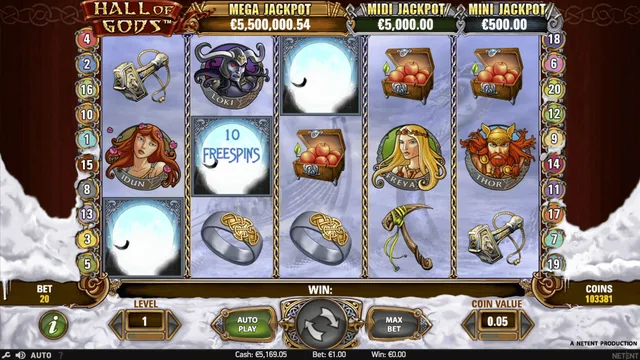
"Jackpot" covers at least four different mechanisms, and the difference decides both how big the prize can get and what the game costs you per spin. A reader who sees a prize meter and a reader who sees "1,000 times your bet" are looking at different products. This article defines each type from the sources that describe them, then works out the price of the progressive kind in rand using the published RTP figures for three slots. It does not tell you which game to play or promise that any pot will fall.
| Type | Who pays the prize | Does it grow? | Example from the rules |
|---|---|---|---|
| Fixed | The game: a set multiple of your stake | No | Jackpot Giant at lower bets pays 1,000 times the total bet |
| Single-game progressive | The players of that one game, through a share of each bet | Yes | The smallest pots, which the Wikipedia article describes as tied to each individual machine |
| Linked or network progressive | The players of every game and casino feeding the pool | Yes, faster | Mega Moolah, with wins at many different casinos |
| Must-hit-by | Players, plus house money for the minimum | Yes, to a limit | The type described on Wikipedia, which must pay before a disclosed ceiling |
A fixed jackpot is simply a top win that is scaled to your bet. OLBG's Jackpot Giant page gives a clean case: five Wild symbols on payline 1 award the Giant Jackpot, but only if you play the maximum £4 per spin. At any lower bet, the same combination pays 1,000 times your total bet. If the total bet were R10, that is 1,000 x R10 = R10,000; at R2 it is R2,000. The size is known in advance, and it does not depend on what other players have wagered.
That example also shows something many players miss. Jackpot Giant is a progressive game, yet most of its stake range is playing for a fixed prize. The meter is only reachable at the top bet. Read the rules for the bet level that unlocks the progressive before you assume the pot on screen is in play at your stake. Our Jackpot Giant review covers the base game.
The Wikipedia entry on progressive jackpots says that every qualifying wager adds a small amount to the jackpot, that the casino sets that amount, and that after a win the jackpot resets to a preset minimum. The smallest jackpots can be tied to each individual machine, and often multiple machines are pooled or linked to form a larger one. The entry also describes a tiered arrangement of a main jackpot, intermediate jackpots paid at regional level and smaller jackpots paid at site level.
The answer to "who pays" is therefore every player who feeds the pool, which is why a linked pot climbs fast. Wins on Mega Moolah are reported at several different casinos, for example Grand Mondial in 2018 and Betway in 2023, which is what a shared network looks like in practice. For the other two examples in this article the sources I opened do not say whether the pot is shared across casinos, so that is not claimed. The mechanics of a four-tier network pot are in our Mega Moolah wheel guide, and a second multi-tier case in the Age of the Gods jackpot tiers article.
The contribution is not extra; it is deducted from what the reels return. Three published figures, each from a game page that states its RTP split, show the size of the deduction. The table converts each to rand per R1,000 wagered, which is an average over a very long run and says nothing about one session.
| Game | Published split | Into jackpot | Returned by the reels | Total expected return |
|---|---|---|---|---|
| Jackpot Giant | 2.98% contribution; RTP 94.22%; 91.24% excluding the jackpot | R29.80 | R912.40 | R942.20 |
| Mega Fortune | 7.6% to the jackpots; RTP 96.6%; 89% excluding them | R76.00 | R890.00 | R966.00 |
| Mega Moolah | 5.3% from the jackpots; base RTP 88.12% | R53.00 | R881.20 | R934.20 |
Sources: OLBG for Jackpot Giant and Mega Fortune, and Casino.org for Mega Moolah. The arithmetic is mine: 1,000 x 2.98% = R29.80 and 942.20 - 29.80 = 912.40, which matches OLBG's 91.24%. For Mega Fortune, 1,000 x 7.6% = R76 and 966 - 76 = 890, which matches the 89%. For Mega Moolah, 88.12 + 5.3 = 93.42%.
The comparison is less about which game is better than about where the money goes. Mega Fortune returns the most in total on paper (96.6%), but it also sends the most to the jackpots (7.6%). Ranked by what the reels alone return, the order flips: Jackpot Giant 91.24%, Mega Fortune 89%, Mega Moolah 88.12%. A headline RTP therefore says little until you know how much of it is held back for the pot. These are single-page figures: RTP can differ by casino and version, so confirm the number in the help screen where you play.
Wikipedia describes the must-hit-by (also called mystery) jackpot as one whose value is fixed right after the previous win and disclosed only as a range. It pays on the wager that reaches the threshold, and often spans several games. Its example formula, $1,000 plus the square root of a random number between 0 and 4 million, gives a 75% chance that the target lands between $2,000 and $3,000: the square root of 1 million is 1,000 and of 4 million is 2,000, so values from 1 million up (three quarters of the range) land in that band.
Wikipedia also says that because only the portion of wagers inside the range funds the pot, the operator must fund the minimum from the main game's house edge, usually at least a third of the must-hit-by amount. This is the one type with real house money in the prize. A deadline does not make any single spin more likely to win, only the pot more certain to drop. I could not open a studio page that defines "must drop" for online slots, so the description is Wikipedia's.
Three checks before staking real money: whether the bet level you can afford actually opens the progressive; whether the displayed RTP includes the jackpot share (the figures above show it does); and whether the pot is single-game, linked or capped. Jackpot totals shown in a currency other than rand are in that currency, not R. South African law does not license online casino games under the National Gambling Act 7 of 2004, so such games come from operators licensed elsewhere; gambling is for adults aged 18 and over. If the chase stops being entertainment, the South African Responsible Gambling Foundation has a free line on 0800 006 008, and you can SMS "HELP" to 076 675 0710. For more jackpot titles, see jackpot slots.
Mostly by players. The Wikipedia entry says every qualifying wager adds a small amount to the pot, and the pot resets to a preset minimum after a win. For must-hit-by jackpots, the same source says the operator funds a minimum from the house edge.
Yes, the share is part of the published RTP. OLBG gives Jackpot Giant 94.22% with 2.98% contribution, 91.24% excluding the jackpot, which is R912.40 returned by the reels per R1,000 wagered. Figures vary by casino, so check the help screen.
Not always. For Jackpot Giant, OLBG says the progressive is only available at the maximum £4 bet; at any lower bet, five Wilds on payline 1 pay 1,000 times the total bet. Other games differ, so read the rules for the bet level that qualifies.
Wikipedia defines it as a jackpot whose value is set right after the previous win and disclosed as a range. It has to pay before reaching the limit. A deadline does not change the chance of any one spin; it only makes the payout certain by then.
Prepared by the CasinoPopular editors from the sources listed above. This is general information, not financial or legal advice. Spotted a mistake? Write to [email protected]. Problem gambling helpline (SARGF): 0800 006 008, free and open 24/7.
Four linked pots, a board of 20 coins and a random start on any paid spin. What the Age of the Gods jackpot game really does, and what the published rules…
A random wheel, four prize tiers and one pool fed by many casinos. What Mega Moolah's jackpot wheel does, what the record wins tell us, and what no source…
Is there a South African deadline after which a bookmaker can keep your idle balance? We checked the national Act and the provincial material. Here is what is…
This site sets no advertising or tracking cookies. Our network provider may set a technical security cookie, and your browser remembers that you closed this note. Privacy and cookies